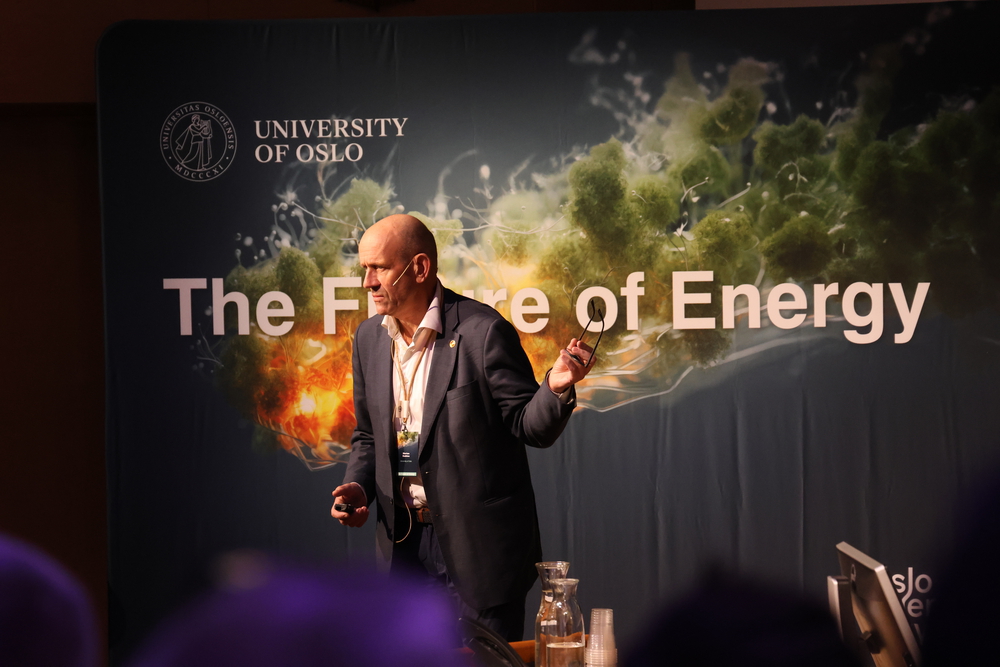
During the opening session at Georg Sverdrups House (Oslo University Library), I had the opportunity to present to a packed audience before engaging in a constructive debate with Torgeir Micaelsen, State Secretary at the Ministry of Digitalisation and Public Governance. In our discussion, I highlighted how vital public investment in research and innovation is for achieving the green transition.
Here are the main points I shared with the audience:
The Green AI Paradox
AI and machine learning are transforming society, offering powerful tools also for the green transition, for example tools for optimising influx of renewables into the energy mix. However, AI-technologies consume enormous amounts of resources - electricity, water for cooling, and materials harvested from a vulnerable nature - which are not inherently “green”. Addressing this paradox is vital in the decades ahead.
Population Growth and Energy Demand
Global population growth has surged from 3 billion in 1959 to 8 billion in 2022, with projections of 10-11 billion by the end of the century. This growth has put and will put immense pressure on Earth’s resources. All these people breathe in the same atmosphere and use more resources than the planet is able to reproduce. Collaborative global solutions, particularly with respect to sustainable energy production, distribution and use, are essential to tackle these challenges effectively. How can digitalisation in general and AI in particular help?
Energy-Hungry Data Centres
Data centres are consuming vast amounts of energy, creating local and global challenges. If current trends continue, that is very much based on the growth in use of AI, their electricity use could quadruple within a decade, rivaling the electricity use of entire nations. This calls for smarter and more sustainable strategies for the development of data centres, including numerous measures for making digitalisation and AI more resource efficient?
The Role of Universities
Universities, including the University of Oslo, play a crucial role in addressing sustainability challenges. Through disciplinary and interdisciplinary research, they are driving solutions for climate adaptation and the transition to "the age of renewables”. Long-term investments in research, both disciplinary and interdisciplinary, are essential. You can read more about this in “The Twin Transition Century” paper from The Guild.
A Call for Public Investment
The green transition is, most likely, humanity’s greatest challenge ever. To succeed, we need a rapid shift to production and use of renewable energy across the globe. This transition must happen fast and within a couple of decades. Incentives and regulations to stimulate the (energy) market are important, but it is difficult to see how this transition can be achieved without massive public investments in research and innovation independent of stimulating market mechanisms.
The Importance of (Global) Collaboration
The energy transition challenge demands strong commitment to national and international cooperation, in research and innovation. Norway, as a strong energy nation, has the expertise and resources to lead parts of this transition. Why not, just do it?
So, how can we tackle the green AI paradox and drive the energy transition? The answer lies in research, balancing innovation with responsibility, scaling up public investments (although it is a little bit painful), and working together—locally and globally. It’s a daunting task, but humanity has faced big challenges before.
Let’s roll up our sleeves and make it happen—because there’s no planet B (and no algorithm to create one either).
Author: Morten Dæhlen
Centre Leader, dScience – Centre for Computational and Data Science


