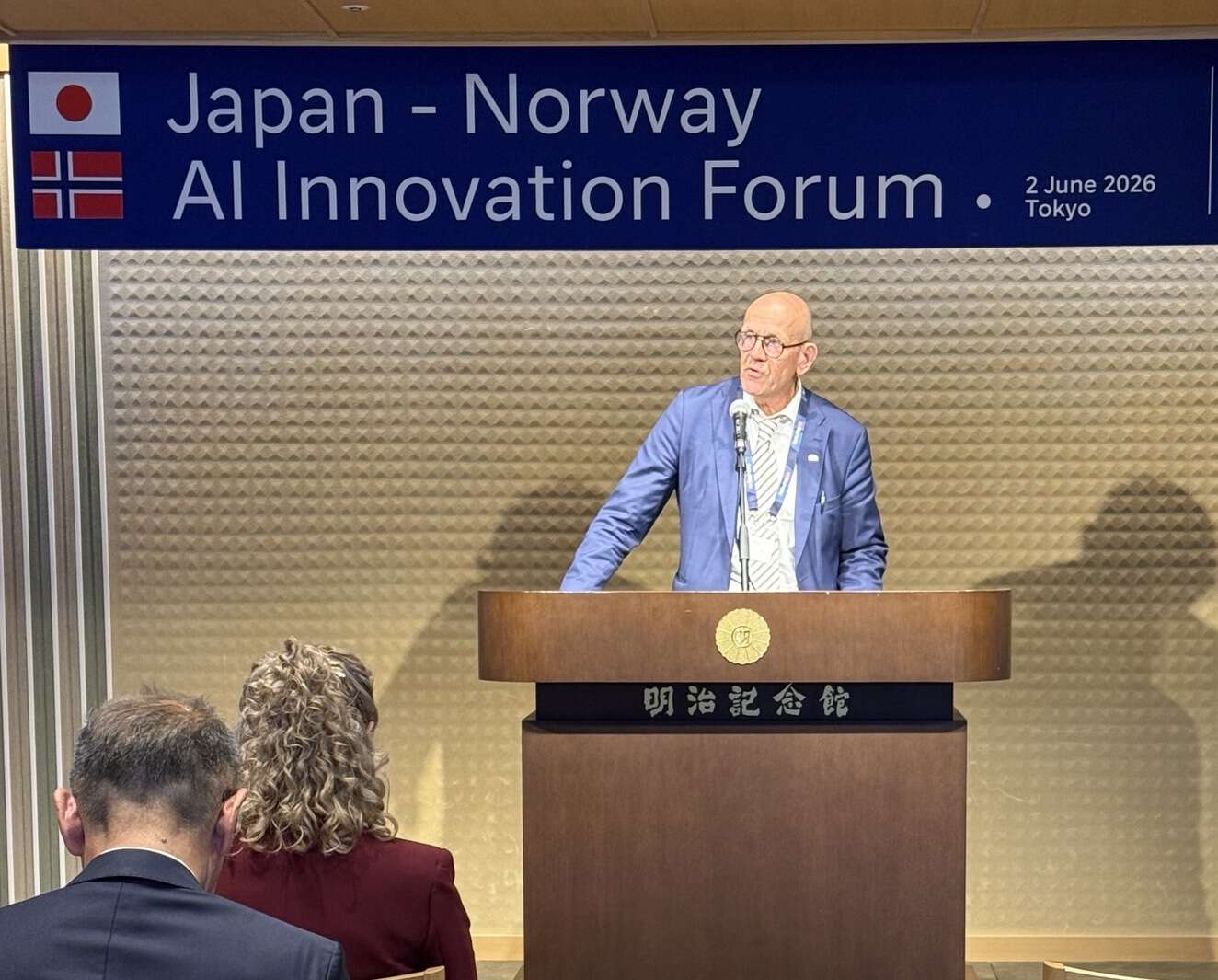
Japan and Norway are two strong maritime nations and AI at sea has the potential of bringing these two countries even closer together. The two countries established diplomatic relations in 1905 - almost immediately after Norwegian independence - with maritime trade and development at the heart of that relationship from the very start. More than a century later, that foundation remains solid.
The Ocean and Maritime Spotlight session at the Japan-Norway AI Innovation Forum reflected that long history. A key reference point was the bilateral agreement on maritime technology collaboration signed at the Nor-Shipping conference in Oslo in 2011.
As a moderator of the session, I wanted to start the session by showing that the relationship between Japan and Norway goes beyond shipping. In 2017, I had the pleasure of visiting Japan when the two countries jointly commemorated the centenary of Kristian Birkeland's death. Birkeland was the Norwegian physicist whose research on aurora borealis (northern lights) had taken him to Japan more than a hundred years earlier. The ceremony honoring Birkelands work in Japan was marked with a new agreement on space technology and physics.
I also took the opportunity to mention that in 2025, the Japanese mathematician Masaki Kashiwara received the Abel Prize for his contributions to algebraic analysis and representation theory. It is a useful reminder that AI is built on mathematics, and that Japan's mathematical tradition is world-class.
The main question driving the ocean and maritime session was approximately as follows: What are the most impactful AI applications you are working on right now, and what are the major challenges in putting them into practice? Five panellists, five organisations, five different perspectives - but with a striking amount of common ground.
- Hideyuki Ando from NYK's Monohakobi Technology Institute spoke about deploying AI across one of the world's largest commercial fleets, including its use in predictive maintenance and improving environmental performance.
- Alexandra Koefoed from Kongsberg Maritime described the work of building AI-enhanced ship ecosystems, and the important balance between automation, AI-guided decisions, and human responsibility.
- Konobu Kimura from Furuno Electric explained how AI is changing what a navigation and sensing system fundamentally is, and what that means for data collection and processing.
- Ryosuke Itai, co-founder of the Japanese startup UMIAILE, presented autonomous robotic vessels designed to continuously map and monitor the ocean.
- And finally, Thomas Tybell from NTNU highlighted central maritime AI research topics and the importance of educating the AI workforce of tomorrow.
What brought all the contributions together was of course technology and AI, but also what is at stake. The maritime sector carries the world's goods and monitors the world's oceans, and the sector increasingly depends on AI to operate more safely and more sustainably around the world. That means developing better AI methods and algorithms, building AI-solutions that can be trusted, preparing and using high-quality data from numerous sources, and last, but not least, thinking carefully about the role of humans when «intelligent» machines become companions at sea.


