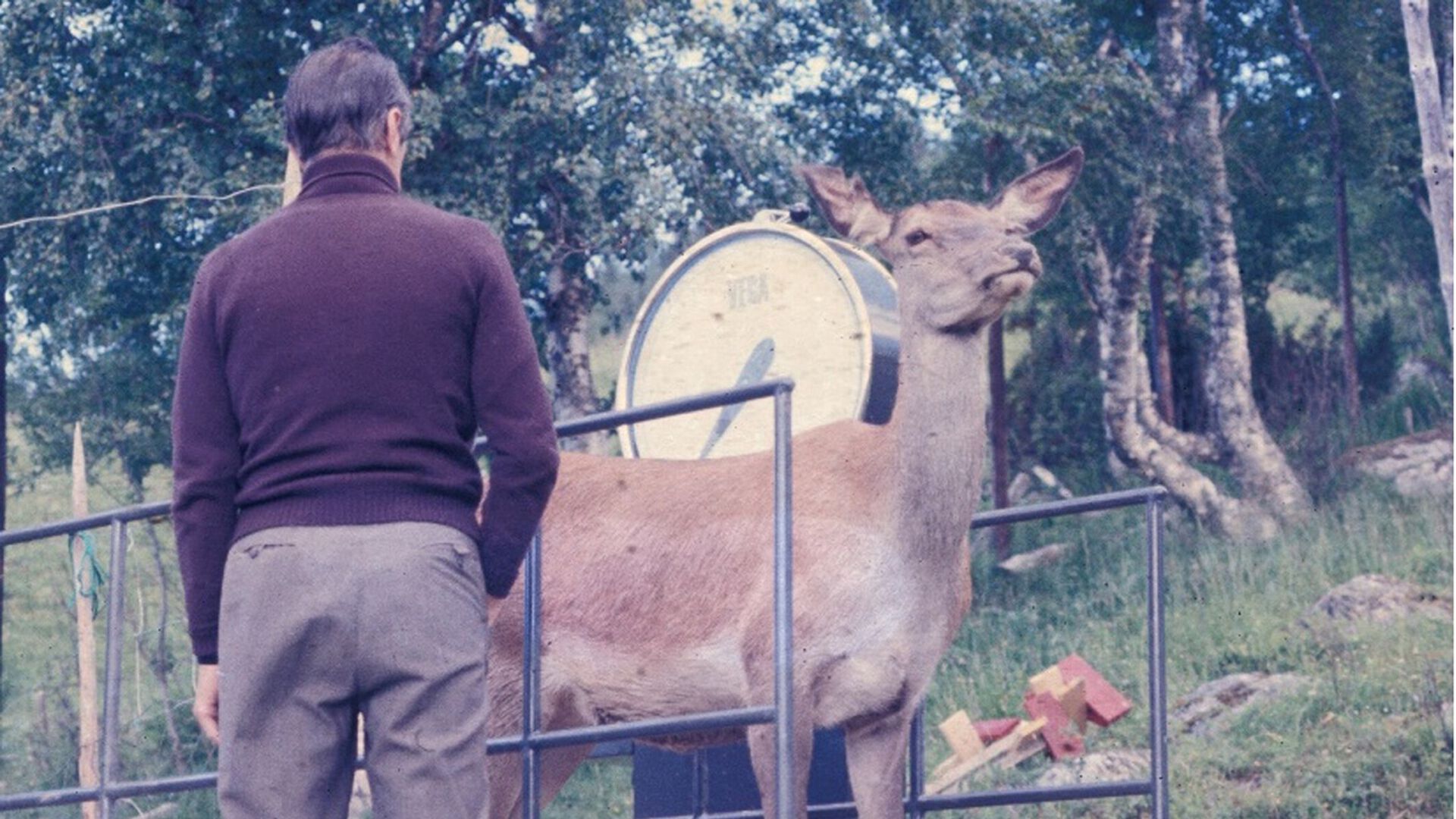
When researchers began investigating the weight of deer, they found large fluctuations throughout the year, even with captive deer that were fed during winter. The data used for the research dates back to the 1970s. However, it was only recently that the weight issue had come up in connection with other research questions:
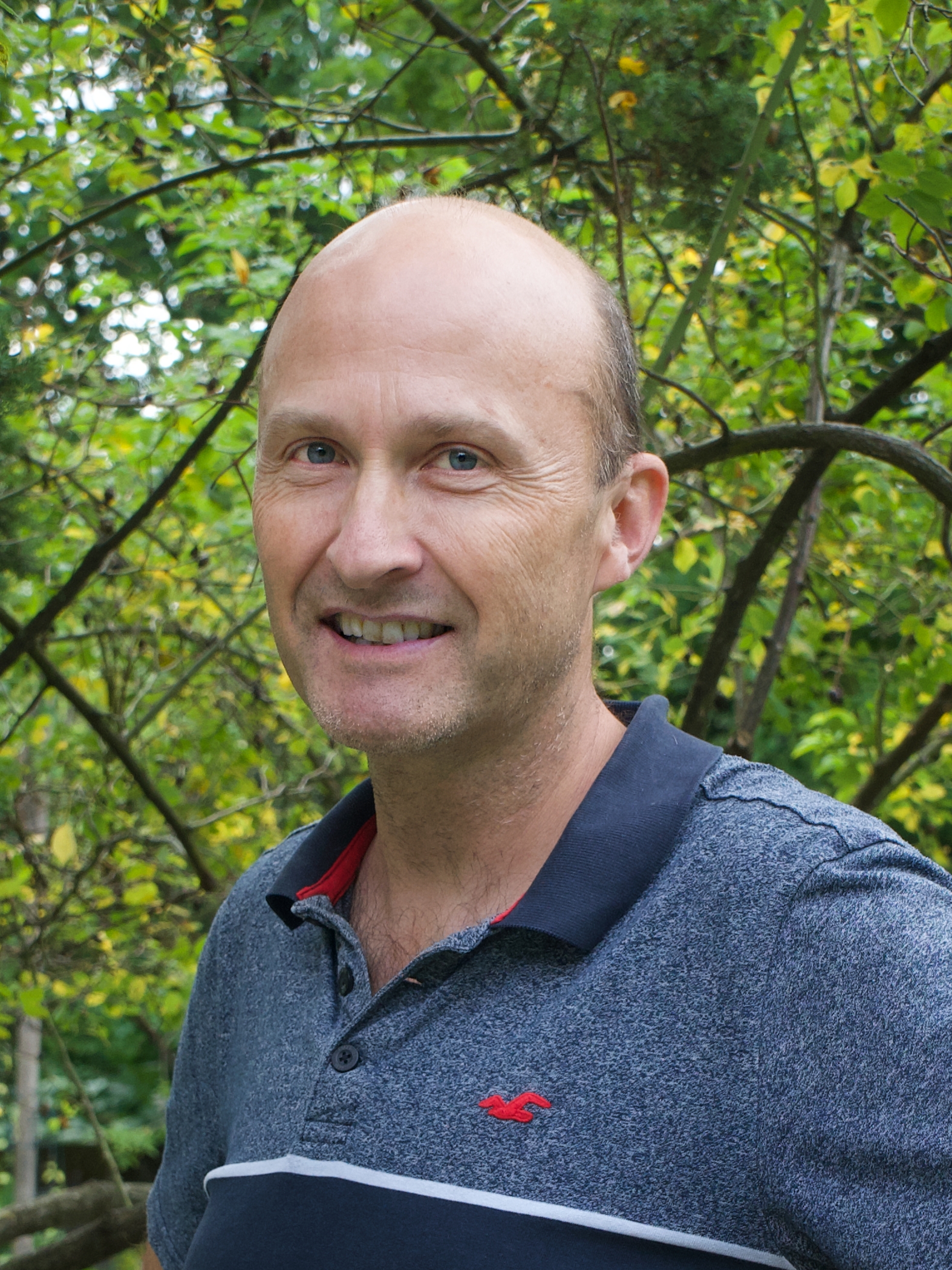
“We are creating models to determine how the deer population is affected by grazing on cultivated land,” explains Yngvild Vindenes, associate professor in population dynamics at the University of Oslo.
Together with Atle Mysterud, a professor in ecology at the Department of Biosciences, she will create models for how a population is impacted.
“The deer can grow larger on cultivated land than on uncultivated land, and it has a better survival rate. Therefore, the weight of an individual influences the population – or in summary: what does a kilogram of deer mean for the deer population?” explains Mysterud.
Population growth models must therefore be linked to an individual’s weight.
It is known that animals that live in northern areas are subject to significant pressures in the winter. Therefore, their weight varies, but by how much and in what way? It is challenging to weigh wild individuals several times throughout their lives. Therefore, it is not well-documented how much weight wild animals vary, regardless of whether it’s a deer or a bear.
“You cannot capture wild deer as many times as necessary for this research,” says Vindenes.
Solid basic research from the 1970s
Fortunately, there is good data available. Basic research conducted at Songli research farm from the 1970s to the 1990s had good data points. Rolf Langvatn, a former senior researcher at the Norwegian Institute for Nature Research (NINA) and professor at the University Centre in Svalbard (UNIS), was a central figure in this work.
For several decades, he has weighed, measured, and collected data on wild deer. He also followed up on several captive animals at Songli research farm. The animals recognised him, and they had names such as Frida and Fredrik.
“There have been deer at Songli visiting farm since the 1950s,” explains Langvatn.
“The number of individuals was few, but there were many data points per individual,” Vindenes adds. The research was conducted on captive animals with standardised feeding. The fluctuations in weight would likely be even greater for wild animals with more variable access to grazing.
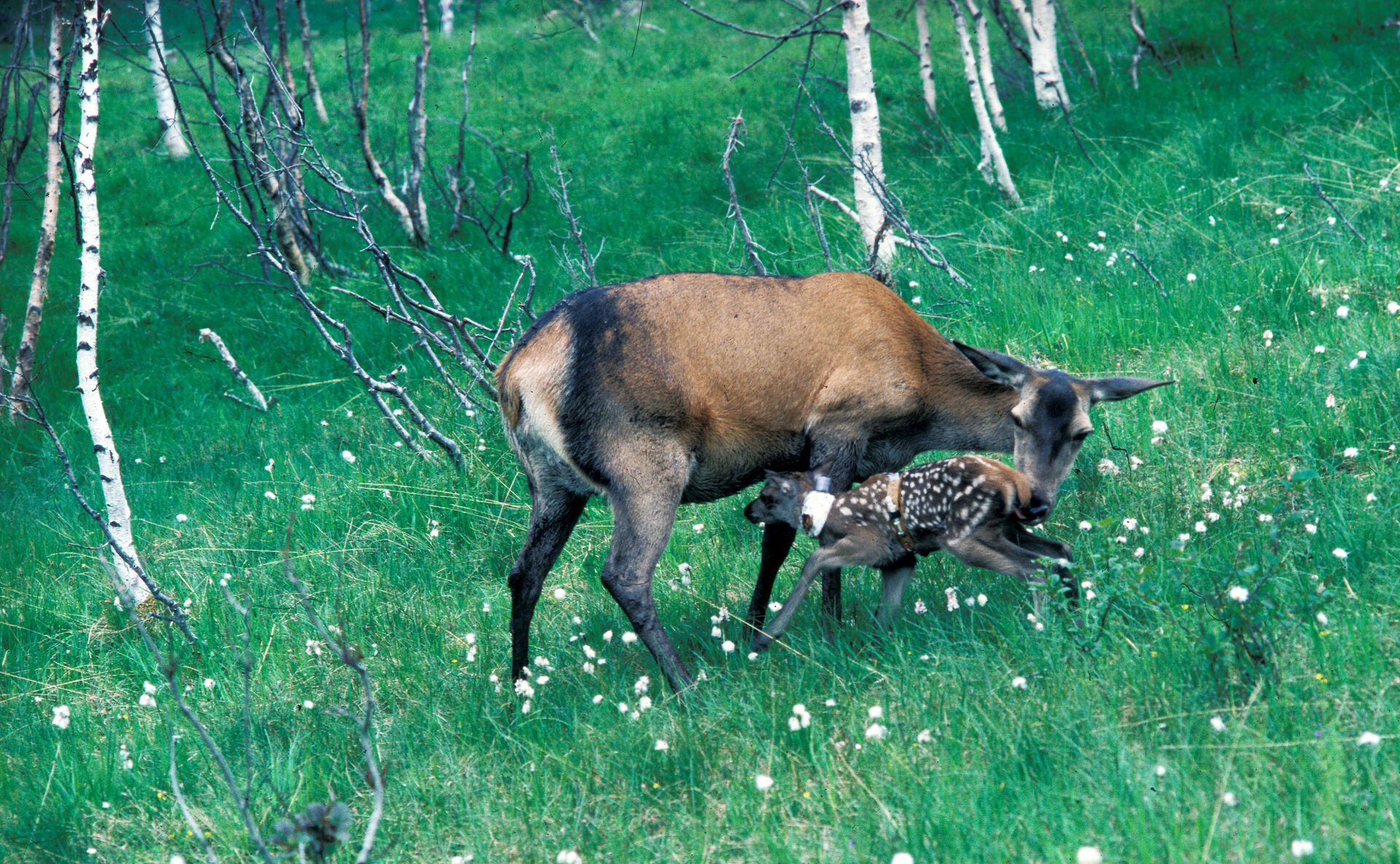
The adult animals are largest at the start of the hunting season
Vindenes used weight measurements on 74 of the captive animals that Langvatn had followed for over 20 years and determined which models best fit the actual observations.
“The model that appears to be the best fit is the one that shows weight not only fluctuating with the season, but also that the peak shifts with age,” she says.

They found that the calves are largest in December, before getting thinner throughout the winter. The adults, on the other hand, are largest in September. This is likely noticeable to many hunters. At the start of the hunting season on 1 September, some calves are still quite small, while calves shot closer to Christmas are often larger.
“We speculate on why the adults stop growing in September. Couldn’t they keep eating longer? It’s natural to think it has something to do with reproduction and the breeding season in October,” says Vindenes.
Langvatn also highlights the importance of how the hormone composition changes in deer seasonally. In winter, they go into "energy-saving mode" with a low metabolism, in addition, they change their behaviour to less energy-demanding activities.

Facts: How much does a deer weigh?
The weight of deer is dynamic throughout life, between seasons, and from day to day and throughout the day.
Females, or hinds, grow rapidly until they are 2-3 years old. Then growth decreases significantly while they give birth to their first calf, and their energy is directed towards nursing. From 5 years and beyond, the weight of hinds in autumn is relatively stable before decreasing in old age after 20 years of age.
The weight of bucks varies more than for hinds. Bucks continue to grow longer, peaking at around 10-12 years, but then their weight decreases rapidly with increasing age. Bucks can lose 20-30 kg in October when they are active during the rutting season.
In the large Norwegian encyclopedia, it is stated that the weight of a female can reach 150-170 kg and a male 240-260 kg. At Songli, the average weight of an adult female was 130 kg, but varied from 86 kg for "Trine" to 174 kg for "Lisa".
The average weight of an adult male was 177 kg, with a variation from 109 kg for "Sofus" to 226 kg for "Albin".
Adult deer weigh the most in September. All deer weigh the least in March.
The weight of an individual can vary by up to three kg in one day.
In western Norway, the weight of deer has significantly decreased in recent decades due to increased and very high population density.
Sources:
Langvatn, Rolf: hjort in Store norske leksikon at snl.no. Retrieved on August 30, 2023, from https://snl.no/hjort
https://www.miljodirektoratet.no/globalassets/publikasjoner/dirnat2/attachment/879/dn-notat-4-2003.pdf
Norwegian Directorate for Nature Management, 2003. Note 2003-4.
A herd of domesticated research animals
The research animals had to be domesticated for this research to be possible. Wild animals would have been stressed by the weighing process, and it is not possible to track a wild individual in the same way. Langvatn further explains that deer are suitable research animals because they are social herd animals and can be domesticated.
"We could pet them, and they would come when they heard us," he says. "In order for the data we collected to be reliable, we had to work with trusting animals so stress wouldn't affect the results. When we approached the enclosure, it was almost a fight to get on the scale because they knew they would get a handful of oats."
He and the other researchers weighed the deer regularly to obtain precise measurements of the cyclical changes in weight throughout the year.
"We did this with domesticated animals, but no matter how you feed a deer, it will lose weight in winter. This is an adaptation to life at northern latitudes," says Langvatn.
The amount of data is so large they still haven't analyzed everything
Langvatn knew that good time series, with accurate measurements were important, but he didn't know the significance this research would have. The amount of data they helped collect is so large that not all of the material has been analyzed yet.
"I started collecting jaws and data from animals shot during hunting. We have measured and weighed over 100,000 wild individuals from different parts of the country. Based on this, we have been able to show some correlations between climate, weather conditions, the quality of the animals' habitats, and how this affects their survival. It is possible that this is the world's largest database for deer where the measurements and methods have been consistent throughout the entire time period," says Langvatn.
Long and accurate time series are extremely valuable.
Langvatn explains that there is a lot of research showing the importance of accurate time series over time.

"The North Atlantic Oscillation was discovered because someone measured variations in air pressure in Iceland and the Azores. Small differences in air pressure leads to significant differences in weather. These measurements started in 1864, long before anyone knew the significance they would have," explains Langvatn.
"The great value of such data is that it can never be reconstructed with certainty in the future. What was measured a hundred years ago serves as reference points and scientific landmarks that allow us to trust trends that arise in these datasets. That is why this deer time series is very valuable," he says. "There are no alternatives to acquiring facts when trying to understand ecological systems. We have to make measurements and observations over time."

Norwegian deer research is internationally known
Langvatn explains that Norwegian deer research is well known internationally. When activity level at Songli was at its peak, there were many international researchers conducting their experiments there.
"Many people have looked at the data we have in Norway. It is exciting that top universities, such as Cambridge, have been involved," Langvatn says.
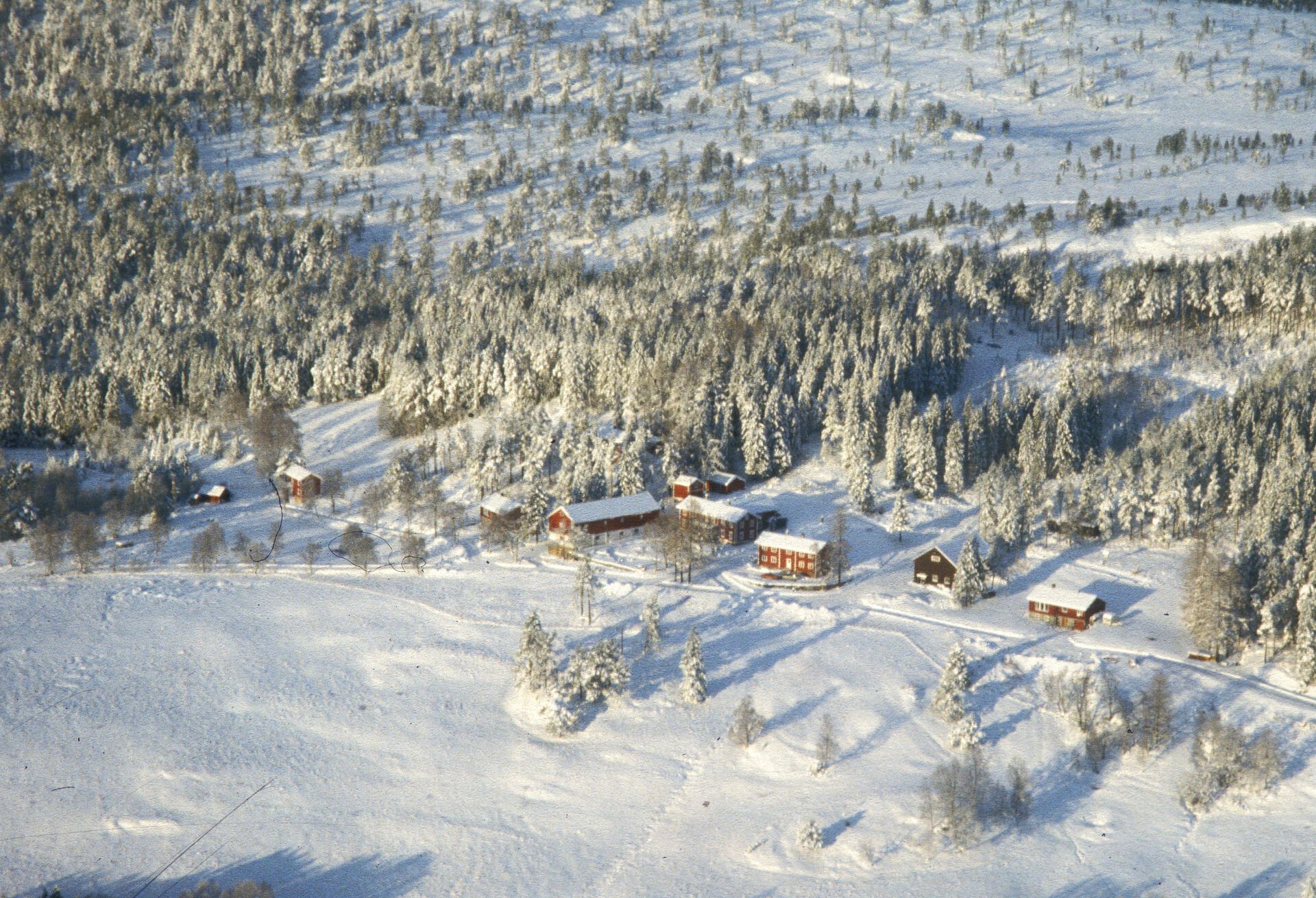
Langvatn collaborated with Scottish researchers who were experts in observation and behavior. The Scottish researchers had information and research that complemented the Norwegian physiological and ecological experiments. The research could never have happened if it hadn't been for the Songli research farm:
"Songli was purchased by the state with the purpose of being a research station for wildlife and freshwater fish. Businessman Thams, who previously owned Sognli, had an enclosure with tame deer on the property. This allowed us to do some fundamental research on deer reproduction, growth, and development," Langvatn explains.
"It is sad that the management of this property has not continued as it was intended. Today, the property is research-wise idle," Langvatn concludes.
Fact box: Songli research farm
Songli research farm is a property that the state purchased from businessman Christian Thams in 1952. The property is 78,000 acres and is located 300 meters above sea level in Orkanger municipality. Research activity on the farm began in 1954. There is no exact end date given for the research activity, but the last deer was moved from the farm in 2002.
In a note from 2003, the Norwegian Directorate for Nature Management writes that "the main purpose of acquiring the property - the only one the state has acquired for this purpose - was to serve as a research farm for wildlife research and wildlife conservation, as well as research and experiments related to freshwater fish".
Scientific articles:
Yngvild Vindenes, Rolf Langvatn, og Atle Mysterud, Shifting Seasonality of Annual Growth through Ontogeny for Red Deer at Northern Latitudes, Ecosphere, august 2023.
Mysterud, A., Yoccoz, N.G., Stenseth, N.C., and Langvatn, R. 2001. Effects of age, sex, and density on body weight of Norwegian red deer: evidence of density-dependent senescence. Proceedings of the Royal Society of London.
Yoccoz, N.G., Mysterud, A., Langvatn, R., and Stenseth, N.C. 2002. Age- and density-dependent reproductive effort in male red deer. Proceedings of the Royal Society of London.
This article is translated by Åslaug Brynildsen.


