
If fish poop mostly ends up on the seabed, it’s good news for the climate. This implies that fish play a crucial role in the carbon cycle by transporting CO2 to the ocean floor.
Jesper Nilsen Negård is a master student at the University of Oslo. He studies biosciences and has been tasked with determining fish's contribution to the carbon cycle.
"I will be looking at cod, saithe, and herring in the Oslofjord," he says.
The fisheries themselves are responsible for the fish being smaller and the populations shrinking
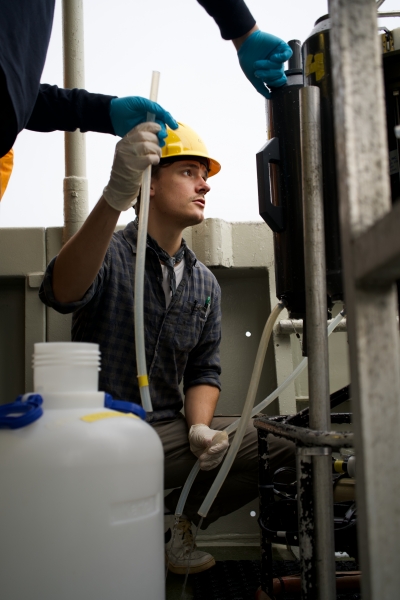
Two of the factors he will investigate are the extent to which the feces dissolve on the way down and, consequently, how much actually reaches the sea bottom and stays there. Additionally, he will assess if the size of the fish has any impact.
During the project, he has participated in several expeditions aboard the research vessel Trygve Braarud. What he has observed concerns him.
"We have seen a decline in the fish population in the fjord," states Negård. Both in numbers and in size.
"Fish populations and the size of fish have been declining for several decades. Much longer than the monitoring project in the Oslofjord has been running," adds Negård's supervisor, postdoctoral researcher Olli Petteri Hyvärinen.
Negård explains that this phenomenon may, in part, be attributed to a concept known as "fishing down the food web." This indicates that fisheries initially target the largest fish. As these are depleted, they shift their focus to smaller and smaller fish.
"As a result, we see that the fish are getting smaller, which in turn impacts the carbon export they contribute to," says Negård.
The contribution of fish to the carbon cycle can be highly significant, but the exact figures are not yet known
The phenomenon of carbon transport via feces is well-known in copepods and zooplankton, says Negård.
"Globally, it is estimated that zooplankton help store up to 6.5 gigatons of carbon each year. It's a kind of natural climate solution," he says.
This is why they are now taking a closer look at the contribution of fish.
"Fish contribute to carbon storage, but we don't know the extent of their contribution. Our goal is to quantify it," says Negård.
It’s challenging to study cod for a master's thesis when the population is so small
Negård hopes to measure the fishing industry's carbon footprint, not in terms of emissions from boats, but from the absence of large fish.
"Unfortunately, this has already become more difficult to determine. There are far fewer fish in the Oslofjord. On one of the trawl trips, we caught only one cod. And it wasn't big. That's very little," says Negård.
He explains that while there are generally plenty of fish in the Oslofjord, the research team has caught so few cod on the last two expeditions that it could be challenging for him to write a master's thesis based on this species.
"So we will also look at saithe and herring. Saithe have a similar lifestyle to cod, and we can compare this with herring, which are much more abundant," says Negård.
This is how they measure fish poop sinking
"Finding the sinking rate is very simple. We have a cylinder with filtered seawater. Then we drop the feces in and see how long it takes," explains Negård.

However, obtaining the raw material for the experiment is a bit more complicated.
"We take the fish in a bathtub and let them do their thing. A more reliable method is to dissect the fish and retrieve it from the stomach," says Negård.
The dissolution rate is more complicated.
"We first need to see how we can keep the poop suspended. Over time, we will observe how much of the carbon dissolves into the water and how much remains. Additionally, we will look at the contribution of bacteria to the decomposition process and measure the CO2 emissions along the way. This will give us an indication of the breakdown process," Negård explains.
Preserving fish populations can also benefit the climate
Negård explains that it would be interesting to take samples from the bottom, but according to him, it can be difficult to distinguish the carbon contribution of fish from that of other species.
About the project:
The thesis is part of a larger project called Coastal Ecosystem Dynamics Under Anthropogenic Pressures, a collaboration with multiple stakeholders that examines areas in Skagerrak, Kattegat, and the Oslofjord (SKO) to gain a better understanding of dynamics in coastal areas.
One of the pioneers behind the methods Negård uses is collaborator Angela Martin at the University of Agder.
"What is called marine snow, small pellets from copepods and various fish, is part of the carbon on the bottom. Some of it also comes from humans, so there's a lot going on down there. It's difficult to distinguish who contributed what," he says.
He hopes that if people realize that fish make an important contribution to the climate, there will be a self-interest in preserving the populations.
"We need to store carbon. There's too much of it in the atmosphere. So, everything counts. This might also be a more cost-effective way to take care of the climate," concludes Negård.
This article is translated by Åslaug Brynildsen.


