
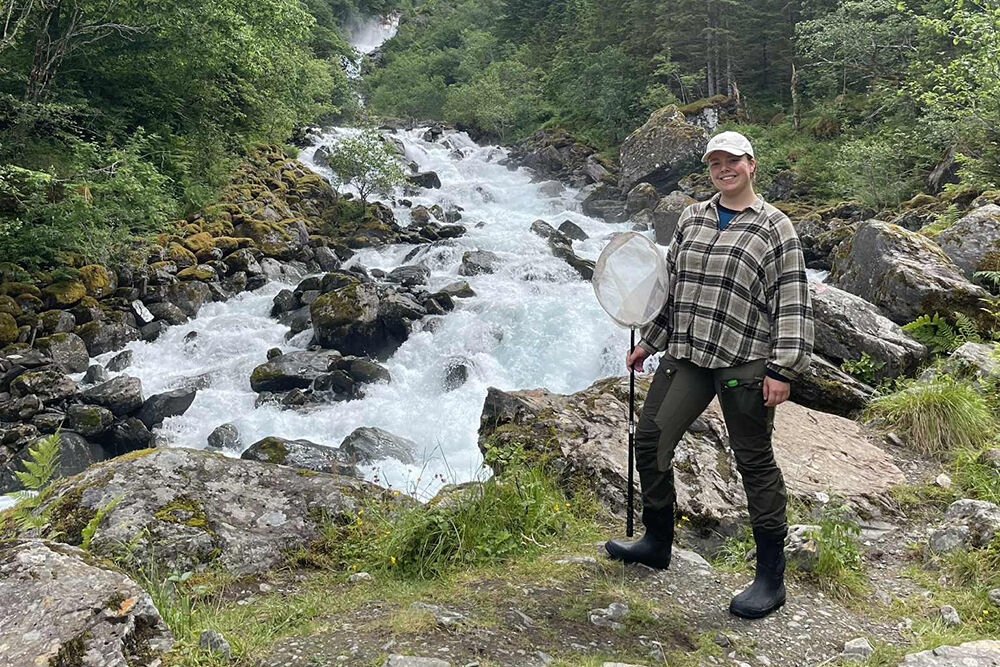
“We know quite a lot about wild bees. We know where many species are found. We also know what they look like, which flowers they like, how they build nests, and so on,” says PhD candidate Marianne Strand Torvanger at the Department of Biosciences, University of Oslo.
“But we know very little about how different populations are connected, how they are in contact with each other.”
The thing is that even if two different places have roughly the same amount of attractive resources for bees, such as flowers, one place can be buzzing with bees, while there are far fewer bees at the other.
Obstacles in Oslo
“The problem with mapping the dispersal of bees is that they are small and have short lifespans. It is difficult to track them with GPS,” Torvanger explains, before she talks about a master’s student she has supervised.
“The student marked around 450 bees with marker pen on their backs. The bees were caught in four different meadows in downtown Oslo, where there is an aim to facilitate good conditions for bees,” she says.
“But of the marked bees, only six were later found again in other places. That suggests that the connection between the meadows is not particularly good. In the city centre of Oslo there are, after all, quite a few obstacles, such as buildings, traffic and water. At the same time, we only know how things were in the one year the measurements were taken. The year after, it could have looked completely different.”
Dispersal limitation
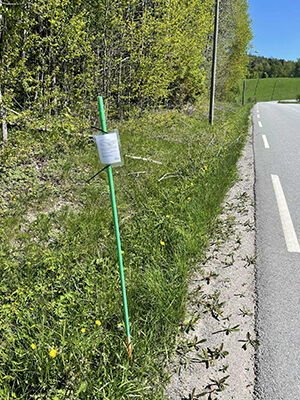
Torvanger has used another method to investigate connections between different habitats.
“We study the species composition in different areas. There are many different wild bee species, and the species composition in an area can change very quickly,” she explains.
“If a species disappears from an area and other species appear instead, and the first species is not found again in similar areas nearby, then there is no necessary connection for that species between the two areas. The species is dispersal limited.”
Can draw maps of dispersal routes
The best connections Torvanger and her research colleagues call are linear landscape segments (LLS).
“These are landscape features that function as green corridors for bees, for example forest edges, roadsides, flower meadows, and edges along agricultural fields. In these areas we often find plants that bees like, such as wildflowers typically found in Norway, Torvanger explains.”
Based on observations of species compositions and landscape segments, they have built a model that can be used to predict dispersal areas and draw maps of dispersal routes for bee species.
Inbreeding in isolated populations
Further in her doctoral work, Torvanger is investigating what characterises travel routes for different groups of wild bees.
“My hypothesis here is that species that are specialists, that is, that depend on only a few flower species, have greater dispersal limitations than species that are generalists.”
“This is important knowledge, because when habitats become fragmented, for example through loss of natural areas, the distances between different bee populations can become too great,” Torvanger explains.
“In isolated populations we get inbreeding, which makes the bees more vulnerable to parasites, diseases, and other problems. This results in increased risk of extinction.”
Reference:
Sydenham, Torvanger et. al: Role of forest edges and other seminatural linear landscape features in structuring wild bee habitat connectivity in intensively managed landscapes. Conservation Biology, Dec 2025


