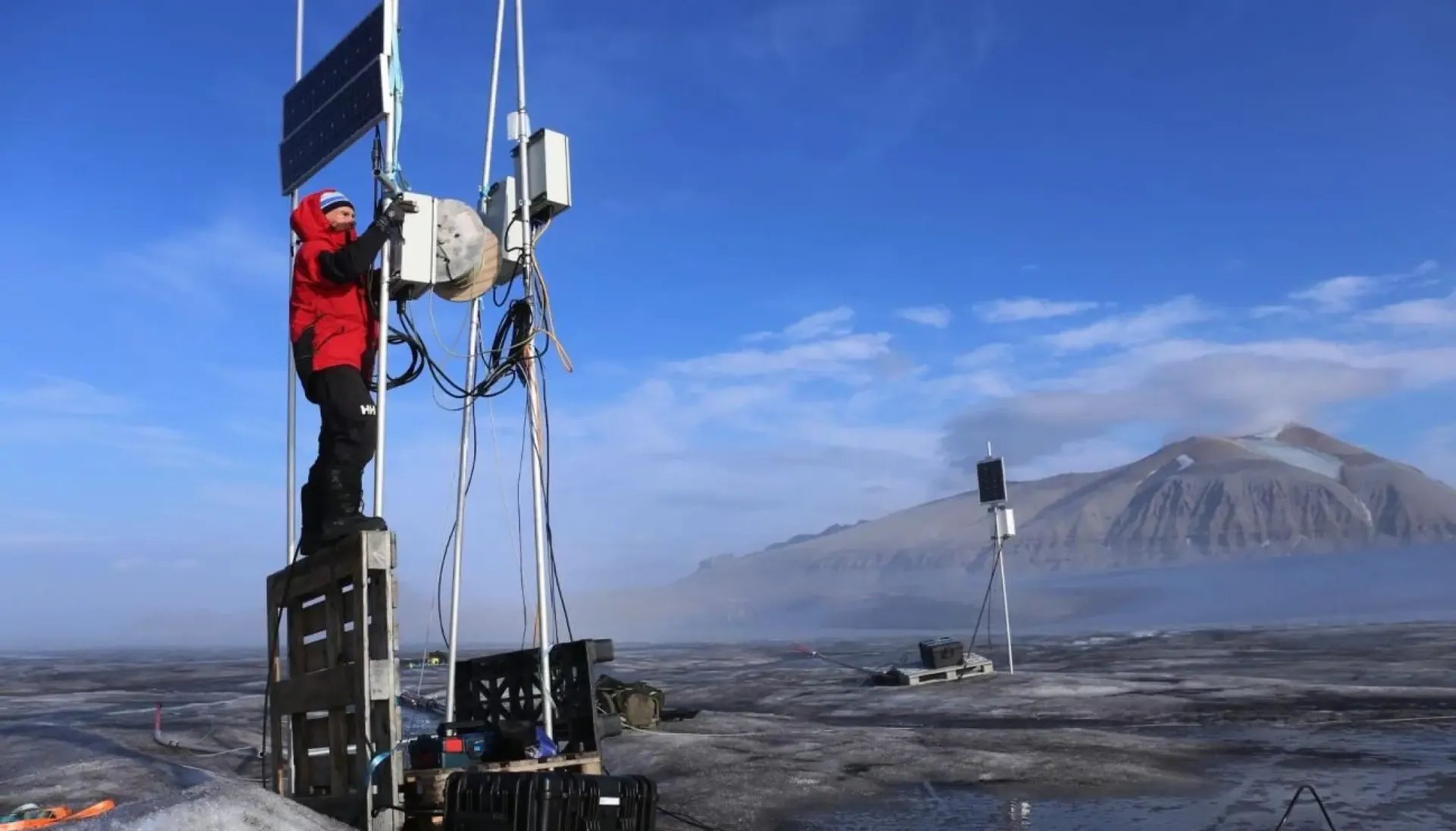
For over 20 years, Thomas Vikhamar Schuler has traveled regularly to Svalbard to research the glaciers on Svalbard, this Norwegian archipelago in the Arctic. The archipelago lies about midway between mainland Norway and the North Pole.

He has seen the ice retreat little by little, but nothing could prepare him for what awaited in 2024.
"Our research models showed extremely high melting, far beyond the normal. I thought there must be something wrong with the model, but after the field visit, I realized that the calculations unfortunately reflected reality", says Schuler, a professor at the Department of Geosciences, University of Oslo.
You can also read this article in norwegian.
At a measurement point high up on the Kongsvegen glacier, in an area where ice usually hardly melts at all, these extraordinary changes became visible.
"The ice had melted down by over two meters. It was absolutely extreme. We had to use some creativity to reach the instrument."
The summer of 2024 marked the hottest recorded on Svalbard, following two previous years of warm summer seasons. The month of August also recorded temperatures well above normal, as measured at Svalbard Airport.

Ice the size of Jostedalsbreen disappeared
A new research study shows that around 61.7 gigatons of ice disappeared from the glaciers in Svalbard much of it just within 6 weeks. This is almost as much ice as the entire Jostedalsbreen, which is the largest glacier on the European mainland.
"That's a lot of water, enough to cover the whole city of Oslo with more than 130 meters of water," says Schuler, who has led the Norwegian study, together with researchers from the Department of Geosciences, MET Norway, the Norwegian Mapping Authority, and the Norwegian Polar Institute with him.
In comparison, Greenland lost 55 gigatons of ice during the same period, even though the Greenland ice sheet is 50 times larger.
The study
The research study titled Svalbard's 2024 Record Summer: An Early View of Arctic Glacier Meltdown? is published in the journal PNAS. The study is a collaboration between researchers from the Department of Geosciences at the University of Oslo, MET Norway, The Norwegian Mapping Authority, and the Norwegian Polar Institute.
Svalbard and other areas around the Barents Sea lost a total of over 100 gigatons of ice in 2024. This made the region one of the largest contributors to sea level rise last year.
Sea levels are rising by about 3.7 millimeters per year. Approximately half of this is due to water expanding as it warms. The other half is a result of ice melting on land and flowing into the ocean.
"In 2024, as much as 10 percent of this sea level rise came from melting in Svalbard. This corresponds to 0.16 millimeters of sea level rise, just from one small archipelago in the north. That is a lot," says Schuler.

Warm air and a marine heatwave resulted in an extremely hot summer
It was record-high temperatures combined with humid air and warm seas that caused the massive melting in Svalbard last year

"For a full six weeks, warm and humid air flowed northward," says Ketil Isaksen
Isaksen is a climate researcher at MET Norway and has studied why temperatures were so high last year.
A stagnant weather pattern with low pressure southwest of Svalbard and high pressure to the east kept the air masses in place. At the same time, the Barents Sea and the Norwegian Sea were affected by a marine heatwave, with surface temperatures up to five degrees above normal.
The result was an August that was 3.7 degrees warmer than normal, with local deviations of over six degrees.
"That is completely extreme. Typically, monthly records are broken by tenths of a degree. In 2024, they were shattered by several degrees", says Isaksen.
Offers a glimpse of the future
"What we saw last year will become common in a few decades", says Rasmus Benestad.

Benestad is a climate researcher at MET Norway. He has examined what the future looks like for Svalbard.
"The models show that such temperatures will become the norm in 20 to 30 years", says Benestad.
It will also get even warmer if we do not reduce our use of fossil energy sources.
"If our emissions remain high, the temperatures we recorded in 2024 will be considered a cool summer in Svalbard by the end of the century."
Significant consequences for sea levels and nature
As warming continues, the glaciers in the Arctic will lose even more mass.
This will cause sea levels to rise faster and impact the nature of Svalbard and the rest of the Arctic region.
Sea level rise
Ice loss from Svalbard in 2024 contributed to a rise in sea level equivalent to 10 percent of what the IPCC estimates as sea level contributions from all glaciers worldwide, on average. The figures on global sea level rise and its components are sourced from the IPCC AR6, Chapter 9, and are based on observed sea level changes during the period 2006-2018.
"The summer of 2024 in Svalbard gives us a glimpse of what the anticipated melting of Arctic glaciers will be like," says Schuler.
In the last five years, a significant amount of ice has melted in Svalbard. Researchers are now closely monitoring whether 2025 will be another record year for Svalbard.
The article is based on a press release in Norwegian first published on met.no
The scientific article:
Schuler, T.V., Benestad, R.E., Isaksen, K., Kierlulf, H.P., Kohler, J., Moholdt, G., L.S., Schmidt. 2025. Svalbard’s 2024 record summer: An early view of Arctic glacier meltdown?. Proceedings of the National Academy of Sciences (PNAS), 122 (34) e2503806122


