
The summer of 2018 was characterised by record-high temperatures, wildfires, poor harvests, and concerns about water supplies in several parts of Europe. In Norway too, the drought left its mark on the summer, with saving measures and restrictions on water use. There was major concern among farmers about their crops.
Researchers at the University of Oslo have now established a database – the Norwegian Drought Impacts Database (NODID). It shows how drought impacts were reported in Norwegian media from 2000 to 2018, and how the coverage is connected to drought indices commonly used in hydroclimatic research.
EDII, the European Drought Impact Inventory; Stahl et al., 2016). EDII defines 15 sectors, each with several subcategories. The Norwegian database contains a total of 356 reported drought impacts distributed across 13 different sectors.
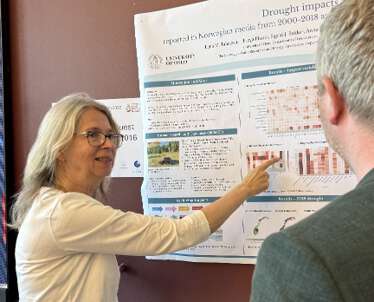
The researchers have received considerable attention for this work, and NODID has been presented at conferences, most recently on 28–29 May 2026 in Copenhagen at the Nordic Baltic Drought Symposium and at EGU in April.
It began with a master’s thesis in hydrology by Frøya Pharo at the University of Oslo (UiO). Pharo and theirs main supervisor, Lena M. Tallaksen at the Department of Geosciences, established a drought database for Norway based on the EDII classification system developed in an earlier EU project. It was tedious work and each impact report identified had to be manually controlled before entering the database.
An extreme drought summer in a historical perspective
Drought is a complex natural phenomenon that can affect large areas. It is caused by less precipitation than normal over an extended period of time, often combined with high evaporation, referred to as summer drought.
"Drought means that less water than normal is available and affects all components of the hydrological cycle, including soil water, streamflow, and groundwater. For that reason, drought has a wide range of consequences and impacts several different sectors such as agriculture and forestry, the energy sector, and water supply,” says Lena M. Tallaksen, professor in hydrology at the University of Oslo.
The hot and dry summer of 2018 was prominent in Norway, with record high temperatures at several meteorological stations. Norway has a temperate and subarctic climate with rather cool summers. The average temperature in Norway from May through July was 3.1 degrees above normal, according to the Norwegian Meteorological Institute.
The 2018 summer brought increased attention to the wide-ranging impacts associated with drought and highlighted the need for more knowledge about the sectors affected and how the impacts reported can be linked to the severity of the hazard.
From “hazard warnings” to “impact-based warnings”
Drought is usually forecasted on the basis of hydrometeorological variables such as precipitation, temperature, streamflow, and water levels in lakes and groundwater. For society, it is not only the weather itself that matters, but how extreme weather affects society, the economy and ecosystems, that is what is on the ground.
To better mitigate the consequences of – and be prepared for – extreme weather events, the World Meteorological Organization (WMO) has called for a shift from hazard-based to impact-based forecasting and prediction of extreme events, including drought.
“This means that we do not merely forecast the event itself, but also what consequences it may have. For example, we will not only forecast how much or how little precipitation to expect, but what consequences this may have for different sectors such as agriculture, energy production, water supply, and ecosystems,” explains Tallaksen.
To achieve this, we need data on the impacts of drought. This is where the NODID database comes in.
A database of drought impacts in Norway
The new database covers the period 2000–2018 and includes reported drought impacts in Norway across different sectors. The data is searched from the Norwegian media archive Atekst, which covers around 100 newspapers, journals, and the Norwegian News Agency (NTB).

As of today, the database contains 302 reports describing 356 specific drought impacts.
Only reports of negative impacts are included
Drought impacts are here defined as negative consequences of drought, ranging from dried-up crops, higher electricity prices, more frequent and intense wildfires, to brown patches on golf courses, bad smells from nearby treatment plants, or neighbours disputes over the right to use water from a stream, explains Frøya Pharo.
“Positive effects, such as a beach becoming accessible where there would otherwise be a river, are not included in NODID. Events that could potentially happen are also not included. For example, increased risk of wildfires in itself is not something we include. It is only once a fire actually occurs that we record it. However, if the fire service introduces a ban on open flames, this can be recorded,” Pharo elaborates.
Which sectors were hit the hardest?
Based on media coverage in Norwegian newspapers and other written sources, the researchers have gained a clear picture of the consequences of drought in Norway between 2000 and 2018.
The dataset shows that certain sectors stand out as particularly vulnerable:
- Agriculture and livestock – reduced yields, feed shortages, dried-out pastures.
- Energy and industry – low river discharge affects hydropower production and access to cooling water.
- Public water supply – low reservoir levels and limited capacity in infrastructure lead to water shortages and the need for restrictions.
- Forest fires – dry vegetation and high temperatures significantly increase the risk of fires.
The dataset revealed clear patterns in drought impacts linked to seasonal variations, regional differences, and sector-specific vulnerabilities.
The years 2002, 2014, 2017 and especially 2018 showed the highest number of reported impacts across sectors. The drought and heatwave in 2018 affected large parts of Northern Europe, which may limit the adaptive measures that can be taken as your neighbours are suffering as well.
Were some parts of Norway more affected than others in the summer of 2018?
Since the dataset is based on sources from more than 100 newspapers across Norway's diverse hydroclimatic regimes, the researchers also get an overview of which regions and sectors are most affected by drought.
“In 2018 we find especially many articles about agriculture and livestock, and Southern Norway and Eastern Norway are often mentioned as being affected. The reports describe scorched fields, reduced yields, lack of winter feed, forced butchering of livestock, and electricity prices that make it economically unfavourable to use irrigation systems. In addition, the compensation scheme for agriculture saw a record-high number of applications,” says Pharo.
When the numbers don’t tell the whole story
Since the dataset is based on sources from more than 100 newspapers across Norway's diverse hydroclimatic regimes, the researchers also get an overview of which regions and sectors are most affected by drought. SPI (Standardized Precipitation Index) and SPEI (Standardized Precipitation–Evapotranspiration Index).
These indices provide numerical values that indicate how unusually dry it is compared with normal conditions over different time spans. Often, one looks 1–12 months back in time. Very low values indicate extreme drought.
The study finds that drought events characterised by low SPI and SPEI values in summer often coincide with reported drought impacts in NODID. However, the researchers find that not all reported drought impacts overlap with periods of “extremely low” SPI and SPEI levels. Lena M. Tallaksen explains that the relationship between measured drought indices and actual societal impacts is not one-to-one, and elaborates:
“Local conditions, such as catchment characteristics and the ability to store water, seasonal variations, preparedness, infrastructure, and water management also play a role. Going forward, we want to test several different drought indices and expand the dataset so that the statistical analyses become more robust. We have already collected data for 2019, which has added nearly 100 more reports. It is particularly interesting to study 2019, since some of the consequences of the 2018 drought can be expected to occur in 2019, or be reported later.”
The road ahead and collaboration with expert communities in the EU
The work of collecting data from Atekst is continuing. The researchers have also established contact with the expert community at the European Commission’s Joint Research Centre (JRC) in Ispra, which is responsible for and further develops the European drought database – now renamed to the European Drought Impact Database (EDID; Stahl et al., 2026). Such collaboration may be important for enabling the collection of impact data with support of AI, Tallaksen concludes.
Source: scientific abstract:
Tallaksen, L. M., Pharo, F., Bakke, S. J., Fleig, A. K., and Nair, A.: Drought impacts reported in Norwegian media from 2000 to 2018 and their relation to drought indices, EGU General Assembly 2026, Vienna, Austria, 3–8 May 2026, EGU26-17930, https://doi.org/10.5194/egusphere-egu26-17930, 2026.
Other references:
Stahl, K. et al. (2016). Impacts of European drought events: insights from an international database of text-based reports. Nat. Hazards Earth Syst. Sci., 16, 801-819, doi:10.5194/nhess-16-801-2016.
Stahl, K. et al (2026): Towards an operational European Drought Impacts Database (EDID), Nat. Hazards Earth Syst. Sci., 26, 845–861, https://doi.org/10.5194/nhess-26-845-2026
If you are interested in drought, there are a lecture in the GeoWednesday seminar series at the Department of Geosciences at the University of Oslo. The video can be viewed on YouTube (in Norwegian only).


